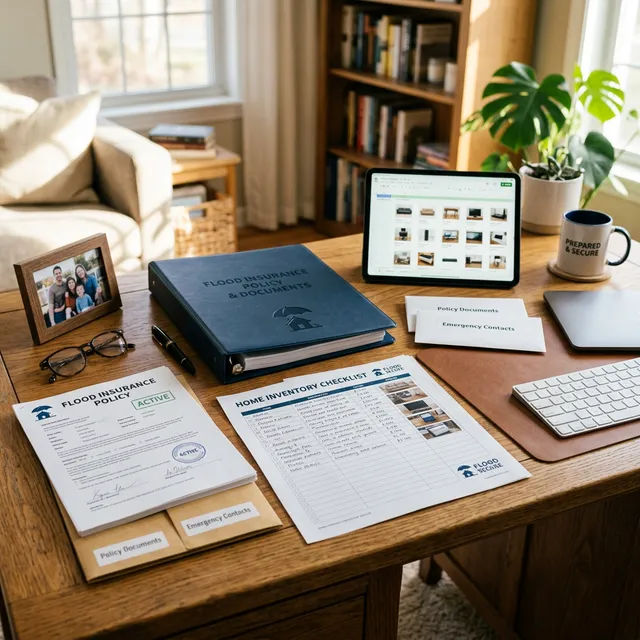
Flood insurance and documentation: understand coverage and protect your assets
Quick Takeaways
- Standard homeowners and renters insurance typically does not cover flood damage. Flood coverage is often separate (through the National Flood Insurance Program (NFIP) or private flood insurance)[1] [2].
- Coverage for sewer/drain backup commonly requires an endorsement. Verify what you actually have, as sump pump overflow coverage may need a rider[2].
- Create a detailed home inventory. Documenting possessions and securing important documents are critical steps to protect your assets and streamline the insurance claims process[4].
- Review your policy annually. Update your coverage and inventory each year or after major purchases.
- Store documents securely. Keep original documents in a fireproof, waterproof safe and maintain digital backups in the cloud.
Who needs to review their flood insurance and documentation?
This guide is for homeowners, renters, and landlords. Flood risks vary by region, including coastal storm surge, river flooding, flash flooding, and urban drainage failures. [2] Review your insurance annually (and before your area’s high-risk season), and update your home inventory whenever you acquire or dispose of significant items. [4]
What are the key differences in water damage coverage?
It is important to understand what your policy covers:
- Standard home insurance: Typically covers some types of accidental water damage that originate inside the home (for example, certain sudden plumbing leaks), but not flood. [1]
- Sewer/drain backup endorsement: Often required to cover damage from sewage or water backing up through sewers or drains. [2]
- Flood insurance: Covers damage from flooding (surface water) under the terms of the flood policy, which is separate from standard homeowners insurance. [1] [2]
Premiums and availability are influenced by flood risk and mapping, and higher-risk areas may face higher costs or fewer options. [3]
What should I do immediately to protect my assets?
Today
- Review your current policy. Identify what types of water damage are covered and note any exclusions. [1] [2]
- Contact your insurance agent/broker or insurer. Ask specific questions about flood coverage, sewer/drain backup coverage, storm surge, deductibles, and limits. [2]
- Start a home inventory. Record major items, take photos or videos, and note serial numbers and purchase dates. [4]
- Secure important documents. Place titles/deeds, wills, passports, insurance policies, and receipts in a fireproof and waterproof safe or sealed sleeves; create digital copies and upload them to a secure cloud service. [5] [6]
This Week
- Consider endorsements and flood coverage. If your policies lack flood and/or sewer/drain backup coverage, request quotes and compare offerings from multiple insurers. [1] [2]
- Calculate replacement costs. Use your inventory to estimate the cost to replace belongings and ensure your contents limit is adequate. [4]
- Organize documents. Create a binder or digital folder for insurance policies, declarations pages, endorsements, warranties, and receipts. [4]
- Install security measures. Set up security cameras that upload footage to the cloud to document your home’s pre-loss condition. [4]
This Season
- Review flood maps and risk products. Use official flood-risk information to understand your home’s risk and what it may mean for coverage and mitigation decisions. [3]
- Update your inventory. Add new major purchases and save receipts and photos. [4]
- Back up data. Keep copies of your inventory and documents on an encrypted external drive stored offsite. [4]
- Educate household members. Ensure everyone knows where documents are stored and how to access cloud backups and insurance contact information. [4]
What is the step-by-step plan for flood insurance and documentation?
- Evaluate current coverage. Read your policy declarations page, identifying exclusions for flood and sewer/drain backup, and note deductibles and maximum payouts. [1] [2]
- Assess risk and needs. Use flood mapping tools and local floodplain information to gauge your flood risk. [3]
- Request quotes and endorsements. Contact your current provider and at least one alternative; compare premiums, deductibles, coverage limits, and exclusions. [1] [2]
- Document possessions thoroughly. Use a home inventory app or spreadsheet, take photos showing items in context and close-ups of serial numbers, and store digital copies in the cloud. [4]
- Secure and back up documents. Place original documents in a fireproof, waterproof safe; keep copies and backups in a secondary location; use waterproof sleeves for evacuation documents. [5] [6]
- Organize policy information. Create a binder or digital file with your policy, endorsements, contact info, and claim instructions. [4]
- Review annually. Reassess your coverage and inventory each year or after major purchases. [4]
- Prepare for claims. After a flood, contact your insurer promptly and document damage before cleanup when safe to do so. [4]
Key Decision Points
- Homeowner vs. renter: Renters generally need renters insurance for contents, while property owners typically insure the building structure. [2]
- High-risk vs. low-risk areas: High-risk zones may have costly or limited flood coverage, making mitigation and documentation even more important. [3]
- Budget considerations: Weigh premium costs against potential out-of-pocket losses, and plan for deductibles. [2]
- Paper vs. digital: Digital systems are easier to update but require reliable backup, while physical binders work without internet access. [4]
What products can help protect my documents and possessions?
| Product Family | Why It Helps | Key Features to Look For |
|---|---|---|
| Fireproof & Waterproof Document Safes | Protects critical documents from fire and water damage. | UL/ETL fire rating & waterproof claims[5]; locking mechanism; adequate size. |
| Cloud Backup Services | Stores digital copies offsite, accessible from anywhere. | Strong encryption; automatic syncing; sufficient storage. [4] |
| Home Inventory Apps | Simplifies documenting possessions for insurance claims. | Photo/receipt uploads; cloud syncing; export options. [4] |
| Waterproof Document Sleeves | Protects individual documents from water damage during transit. | Durable, resealable plastic; various sizes. [6] |
| Waterproof Storage Bins | Protects bulk items from water damage in basements or during evacuation. | Gasketed lids; stackable design; clear sides or labels. [4] |
| Security Cameras | Provides visual documentation of your home’s condition to support claims. | HD resolution; cloud storage; weather resistance. [4] |
| Insurance Policy Binders | Keeps all insurance documents organized for quick emergency reference. | Durable organizer with labeled sections and pockets. [4] |
| Document Scanning Services | Converts physical records to digital format for safer storage and sharing. | High-resolution scans; secure delivery/storage; clear privacy practices. [4] |
What checklist should I follow?
Flood Insurance and Documentation Checklist
- Read your current policy to identify water damage exclusions. [1] [2]
- Contact your insurer to discuss flood insurance and sewer/drain backup coverage options. [1] [2]
- Obtain and compare quotes from at least two insurers. [1]
- Create a detailed home inventory with photos, serial numbers, and receipts. [4]
- Back up inventory data to a cloud service and an external drive. [4]
- Secure original documents in a fireproof and waterproof safe. [5] [6]
- Store photocopies and digital backups offsite or in the cloud. [4]
- Organize policy information and claims instructions. [4]
- Update your inventory and insurance coverage annually. [4]
- Confirm what disaster assistance may (and may not) cover compared to insurance. [2]
What are common mistakes or myths about flood insurance?
- Myth: “Floods are covered by my home insurance.” Reality: Flood damage is typically excluded from standard homeowners insurance, so you must verify (and often buy separate coverage). [1] [2]
- Myth: “I live in a low-risk area, so I don’t need flood insurance.” Reality: Flooding can happen outside high-risk zones, and it only takes one event to cause major losses. [2]
- Mistake: “I’ll remember what I own.” Reality: Without a written or digital inventory, it is easy to forget items during a claim. [4]
- Mistake: “Digital records are enough.” Reality: Keep protected physical copies of critical documents because outages and access issues can happen during emergencies. [6]
- Myth: “Disaster assistance will cover my losses.” Reality: Assistance may be limited and may not replace insurance, so plan as if you are responsible for insurable losses. [2]
When should I seek professional help?
- Consult a qualified insurance agent/broker if you have difficulty understanding your policies or obtaining flood coverage. [2]
- Speak with a financial advisor if premiums are prohibitively high to evaluate risk management and emergency funds. [2]
- Hire a professional photographer or scanning service to document high-value collections. [4]
- After a flood, contact your insurer promptly; consider involving a public adjuster if you disagree with the settlement offer. [4]
Sources
- Insurance Information Institute — Do I need flood insurance for my home?
- National Association of Insurance Commissioners (NAIC) — Understanding Flood Insurance and What to Do During a Flood
- FEMA — Flood Map Service Center (official flood hazard information supporting NFIP)
- FloodSmart (NFIP) — Document Flood Damage
- Understand Fire Safe Ratings | Fireproof Safes | SentrySafe
- Chicago Tribune — Fireproof safes and document storage are essential for emergency preparedness